This blog post was originally written in Chinese and translated into English by AI. The author did not proofread the translation, so there may be errors. If you can read Chinese, you can read the original blog post: https://1q43.blog/?p=12336
Over the past few months, I have been building three layers of contextual memory for my AI Agent.
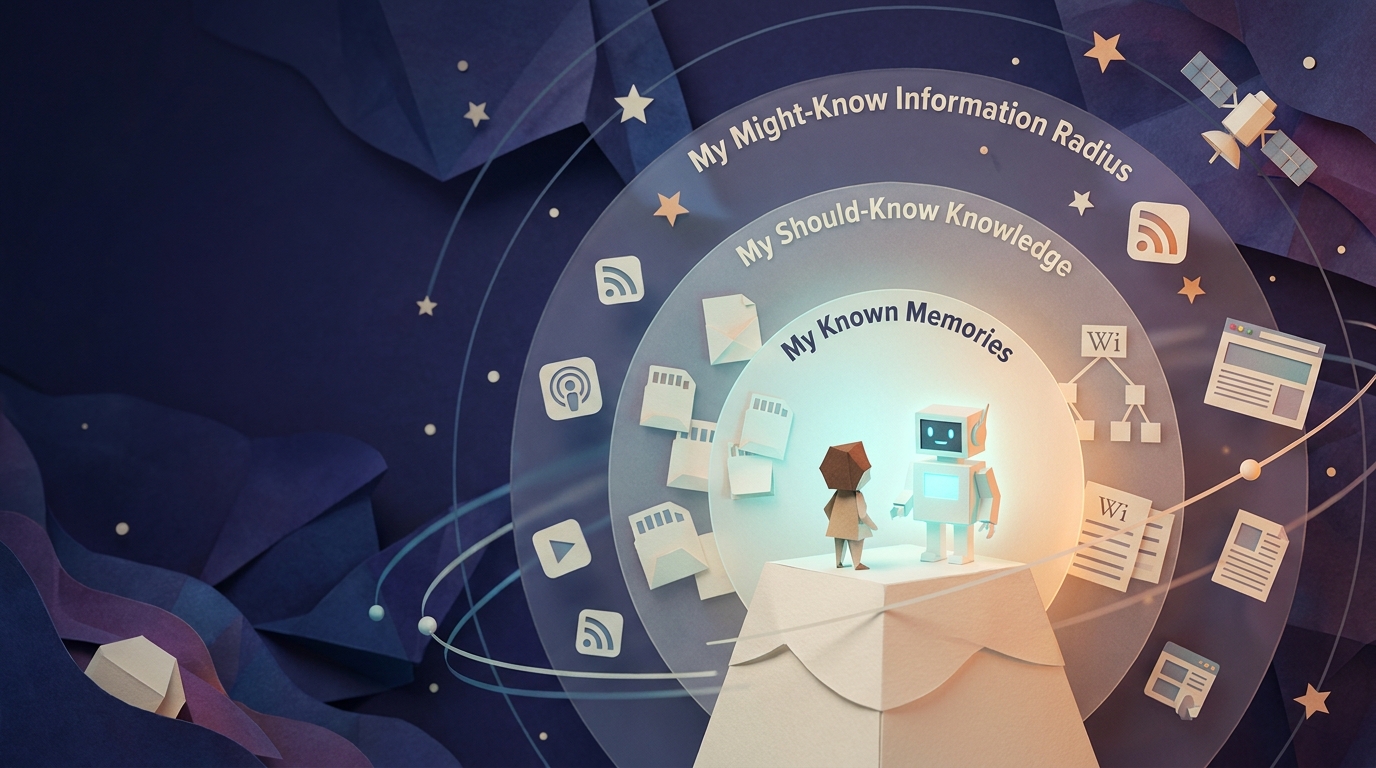
The first layer is “what I know.” The second is “what I should know.” The third is “what I might know.” I call that third layer the “Hubble Radius.”
An AI should not only remember what I have already written down. Nor should it run straight to a public search engine the moment it encounters a question. Before doing either, it should know something more basic: in my world, what kinds of things could I plausibly have encountered?
When people talk about AI memory, they usually focus on two questions: can AI remember me, and can AI look things up? The first is personalization; the second is search. But something important is missing between the two.
AI also needs to know where, from my particular position, I usually perceive the world.
This is the Hubble Radius.
Let me start with the first two layers.
1. RAG and LLM Wiki: First, Let AI Know Who I Am and How I Think
First, the first layer: what I know.
I connected Notion AI to a sliced RAG system. It stores facts only. Each memory is short, usually no more than 200 Chinese characters. Every fragment has keywords, vectors, relationships, and temporal validity, and is stored in a Notion database. The material comes from my articles, diary, Dayflow, Looki, plans, and chat logs.
Dayflow is a minute-level record of Mac usage. Looki is a wearable device that records a short video every few minutes, then extracts a text summary through an API. My diary is a daily review of my own state.
Every morning at 5 a.m., an automation calls Notion AI’s skills and turns these raw data sources into memory fragments. Together, they form a factual memory layer: what I have recently done, what I have been thinking about, where I am stuck, which projects are moving forward, and which judgments I have already made.

The effect of this memory layer is immediately noticeable.
When I chat with Notion AI, a single function call is usually enough for it to know what I have been doing lately. It knows that I have been tuning Hermes Agent, that I am working on research about Chinese and American AI narratives, that I have built interest-based morning and evening briefs, and that although I rely on Notion’s platform advantages, I remain wary of that dependence.
It feels a lot like a personal assistant who is familiar with you.
It may not understand your entire knowledge structure, but it knows what you recently said, what you did, what flags you set, and which pitfalls you just stepped into. AI begins to change from a general-purpose model into “someone who has spent time by your side.”
But this is still not enough.
The limitation of the factual layer is just as obvious: it only records things that have already happened. It knows what I actually know, but not the questions that have not yet been organized into facts, written into my diary, or actively asked.
It is my shadow, but it does not have my thinking.
So there is the second layer: what I should know.
This layer is LLM Wiki. LLM Wiki is a concept proposed by OpenAI co-founder Andrej Karpathy. Put simply, it is a Wiki maintained by AI. Instead of leaving content scattered across a knowledge base in its original form, it reorganizes material into Wiki-style entries that can keep growing over time.
My LLM Wiki is driven by Hermes Agent. It began with all the tinkering I did around OpenClaw, and gradually turned into an intranet knowledge system with FTS5 lexical search, vector search, and a graph structure. It does not simply chop material into pieces and stuff them into a database. It tries to weave scattered material into structure.
It also reads more widely than the first layer.
Beyond the “what I know” facts about me, it also reads articles I have saved, TikTok videos, podcasts, personalized daily reports, and even content I never seriously finished reading but that the system has already captured. Every early morning, Hermes Agent reads the new material added to my Notion that day, then connects, summarizes, merges, and structures it. Over time, it becomes a knowledge network that can be browsed, searched, and edited further.
Sliced RAG is very useful for AI, but hard for humans to read. Open it up and you see only fragments — no structure, no emergent shape. AI can recall details from it, but humans struggle to see the knowledge inside.

This is where LLM Wiki matters. It is not trying to answer “where is this particular fact?” It is trying to answer “what relationships exist among these facts?”
For example, I have long been interested in AI, platform power, consumer culture, non-human actors, workflows, knowledge management, and personal data sovereignty. A single memory can only tell AI: “the user has recently been setting up FreshRSS” or “the user is interested in AI memory layers.” But the Wiki can place these points along a longer line: from my early interest in Rewind, to the desire to automatically maintain a Wiki of “things I know,” to Notion as Me, Hermes, LLM Wiki, interest-based daily reports, and NotionSearch. In fact, these have always been different forms of the same question.
That question is: can I let AI use my context, instead of continuing to hand my context over to platform companies?
The second layer answers “what I should know.” It does not merely remember the past; it begins to organize the past. It turns material into structure, structure into positions, and positions into the background of the next conversation.
By the way, this does not mean the first layer of sliced RAG is unimportant. I have seen many posts on X and Xiaohongshu claiming that RAG is outdated and should be replaced by LLM Wiki. I think this is a very typical false binary.
Sliced RAG is still extremely useful for keyword search, speed, and short factual recall. For example, records from Looki or Dayflow about whom I met on a given day do not need to be solemnly written into an LLM Wiki. They belong in the first layer. When needed, they can be retrieved; when not needed, they can simply sit there quietly.
The first layer is memory cards; the second layer is a Wiki. These two layers are already fairly common practices online, so I do not need to spend too much time on them. But after using them for a while, I found that they share the same boundary: they can only handle things that have already entered my system.
Things I have not saved, read, transcribed, or organized — things that merely appeared in the sources I follow — remain invisible to it.
That is the larger missing piece I want to talk about today.
2. Hubble Radius: the World I Might Know
The third layer is “what I might know.” I call it the Hubble Radius.
I take all the sources I follow — including TikTok, podcasts, websites, WeChat public accounts, Jike, and X — and use workflows built with OpenClaw or n8n to turn as much of them as possible into text, then aggregate them in FreshRSS. I regularly import the full FreshRSS dataset into a private Meilisearch engine, and connect that Meilisearch instance to Notion AI and Hermes Agent as an independent search source.
Meilisearch is an open-source, proprietary search engine. Once set up, you can add any document to it via its API and search the entire database like a search engine. More importantly, it boasts excellent performance, returning search results in milliseconds even with massive amounts of data.
This sounds engineering-heavy. In practice, it is.
I built it on a Sunday afternoon. First I deployed Meilisearch on my Synology, configured ports, volume mounts, and environment variables; then I set up a UI, handled CORS, and checked the indexes. After that, I installed a Meilisearch skill for Hermes Agent, adjusted FreshRSS subscription categories, and divided sources into WeChat public accounts, blogs, academic journals, videos, and other information streams.
Later, I connected it to a Cloudflare Worker as a relay service, with a reverse proxy, API key, field filtering, sorting parameters, and full-text reading. This allows Notion AI to call the private search engine remotely.

That night, when I opened the Meilisearch UI, the index already contained nearly ten thousand documents. For Google, this number is meaningless. But it will keep growing by roughly 2,000 items a week. For a private information library, that is already a fairly large universe.
More importantly, these documents are not tens of thousands of random webpages scraped from the internet.
They come from sources I have manually followed.
The WeChat public accounts are accounts I follow; the podcasts are podcasts I subscribe to; the websites are sites I put into RSS; Jike and X are social fields I chose for myself. Of course, this does not mean I have already read the content, much less that I agree with it. But it does mean that, at some point, I allowed these sources to enter my field of vision.
This is the difference between the Hubble Radius and public search engines.

A public search engine answers: what exists on the whole web?
The Hubble Radius answers: what exists in my information universe?
Why call it the Hubble Radius?
In cosmology, the Hubble radius can be loosely understood as an observational boundary. With the observer at the center, things within the boundary can, in principle, be observed, while things beyond it recede and become increasingly unreachable. I am not using the physics concept rigorously here. I am borrowing it to describe a fact of informational life: each of us has an information radius centered on ourselves.
What you see every day, what you subscribe to, whom you follow, which media you trust, which websites you keep opening, which articles you save, which podcasts you listen to, and even which platforms you waste time on — together, these make up your information universe.
In the past, this universe was mainly useful to platforms.
Platforms know what you watched, how long you stayed, what you swiped away, and what you came back to. They use this data to recommend the next piece of content, sell ads, optimize retention, and keep you inside their universe. But it is very hard for you to use that data for yourself.
You cannot ask TikTok: “Among all the creators I have followed over the past six months, has anyone discussed this particular issue?”
You also cannot ask WeChat public accounts: “Among the media I follow, how has the discussion around AI education changed in the past two weeks?”
Let alone compare podcasts, short videos, social platforms, RSS, and diary entries together.
The platforms possess your information radius, but you do not.
The meaning of the Hubble Radius is to take this radius back and put it into your own AI.
It is not meant to fight Google, nor to replace search on Xiaohongshu, TikTok, or WeChat public accounts. Its purpose is smaller and more private: before AI answers my question, let it first enter my observable universe.
When I ask a factual question, public search is of course important. But when I ask a non-factual question — for example, “has the Chinese internet’s attitude toward AI Agents changed recently,” “why do I feel that certain kinds of content increasingly look like work slop,” or “is feed fatigue emerging among young people” — Google’s first result may not be very useful.
What I want to know more is: within my observable universe, have these things changed?
Because these questions are not looking for a standard answer. They are trying to read a climate.
A climate is not found in an encyclopedia. It lives in the sources I have been exposed to over a long period of time.
3. It Is Not a Search Engine, but a Memory Layer
I think the Hubble Radius is a memory layer, not a search engine.
The core action of a search engine is retrieval. The core action of a memory layer is drawing a contextual boundary.
The same keyword can mean completely different things inside different people’s Hubble Radii. Search for “AI companionship,” and investors, psychotherapists, otome game players, product managers, researchers of minors, and fan fiction writers will each see a different world. Public search flattens these semantic fields, then sorts them by popularity, authority, or advertising logic.
A private Hubble Radius first asks another set of questions:
Where does this term usually appear for you? From whom do you usually encounter it? How have you reacted to it in the past? How have the sources you follow been talking about it recently?
This is not a question of coverage, but a question of weight.
Once AI has access to public search, its biggest problem is often not that it cannot find information, but that it does not know whom to trust. It can open Google, search Xiaohongshu, search TikTok, and read webpages, but it does not know where these sources sit in my world.
Some sources are just noise to me. Some I have trusted for a long time. Some I disagree with, but use to observe a particular position. Some are uneven in quality, but close to frontline sensibility. Some are not authoritative, but can capture cultural shifts earlier than papers do.
Public search does not know these weights. AI does not know them either.
The Hubble Radius knows.
Not because it is smarter, but because its sources have already been filtered once by my past acts of following. Following is itself a slow form of annotation. It is not as lightweight as a like, nor as deliberate as a save. It is more like a continuous authorization: this source is allowed to enter my world.
So when AI searches inside the Hubble Radius, it is not “searching the whole web.” It is drawing on the sediment of my long-term attention.
That is memory.
There is another subtle thing about this layer of memory: what it records is not “I know,” but “I might know.”
The things in the first layer of memory are things I very likely do know, because I have written them, said them, done them, or recorded them. The things in the second layer of knowledge are things I should know, because the system has already organized them into structure and they are waiting for me to call on them at the right time.
The third layer is different. It contains a large amount of content I have never seen at all.
I estimate that, inside my Hubble Radius, more than 99% of the content is material I have not actually read. After all, I follow at least 2,000 subscription sources across websites, WeChat public accounts, short videos, podcasts, and more.
By the standards of traditional knowledge management, this is strange. If I have not read something, how can it count as knowledge? If I have not digested it, how can it count as memory?
But the AI era will change this.
In the past, the bottleneck of knowledge management was human reading time. You might subscribe to 100 sources, but truly read only five. The remaining 95 became little more than anxiety, unread counts, and information debt.
But if AI can help you return to these materials when needed, unread content is no longer only debt. It becomes a callable possibility.
I do not need to finish reading every WeChat public account, podcast, and video every day. I only need AI, when a question arises, to look first inside my Hubble Radius: in the information universe I could have encountered, has anyone already said something similar? Is there a case I missed? Is there a niche discussion closer to my question than what public search would surface?
This approach to information management turns “reading” from upfront consumption into downstream recall.
In the past, we had to read first before we were qualified to remember later. Now we can first establish a radius, and when a question appears, let AI go back into that radius to look for clues. The human role is no longer to swallow all information, but to maintain one’s own observable universe.
I think this will be a major shift in knowledge management in the AI era.
4. The Value of a Radius Comes from Its Boundary
Of course, a Hubble Radius is not better simply because it is larger.
This is its most fundamental difference from public search. Public search pursues coverage; a private radius pursues relevance. You do not need to put the whole web inside it. In fact, you should not. If a private search library eventually becomes a smaller Google, it has lost its point.
The value of the Hubble Radius comes from its boundary.
The clearer the boundary, the better AI understands the context from which you are asking. The more chaotic the boundary, the more easily AI slides back toward the public average.
So the focus of maintaining it is not “grab more,” but “choose.” Which WeChat public accounts are worth keeping? Which RSS feeds have gone dead? Which podcasts were only a phase of interest? Which social accounts often talk nonsense but still have a strong sense of the scene? Which sources should be downweighted? Which are suitable for factual judgment, and which only for emotional sampling?
None of this can be automatically decided by a model.
AI can help you clean, classify, deduplicate, tag, transcribe, and index. But the radius itself must be drawn by a human, because that boundary expresses your history of attention, your structure of trust, and your aesthetic preferences.
This is also why I am increasingly unsatisfied with simply “connecting AI to a search engine.”
Connecting a search engine expands capability. Setting a Hubble Radius expands subjectivity.
The former makes AI better at looking things up. The latter makes AI feel more like it belongs to you.
Put the three layers of memory together, and the relationship becomes clear.
The first layer, “what I know,” is factual memory. It lets AI remember my recent situation, preferences, projects, and judgments.
The second layer, “what I should know,” is structural memory. It weaves facts and materials into a Wiki, allowing AI to understand my long-term questions and knowledge network.
The third layer, “what I might know,” is radius memory. It turns everything I have long followed but may not have read into a recallable information universe, allowing AI to enter my information boundary before it enters the public internet.
The innermost layer is the traces I have left behind. The middle layer is the structure into which those traces have been organized. The outermost layer is the world I might have encountered.
If we use a person as an analogy, the first layer is memory, the second layer is knowledge, and the third layer is vision. A truly personalized AI cannot have only memory and knowledge. It must also have vision. Otherwise, it may know what you did yesterday and recite the definition of a concept, but it still does not know where you usually perceive the world from.
This is what leaves me dissatisfied with many AI personalization products.
They understand “remembering the user” as remembering preferences: what tone the user likes, where the user works, what project the user is doing. They understand “connecting to the outside world” as searching webpages. But a user is not a preference table, and the outside world is not an undifferentiated list of webpages. Between the user and the world lies a long-formed relationship with media.
The Hubble Radius records precisely this relationship.
5. Everyone Needs Their Own Hubble Radius
I tend to believe that in the future, everyone who uses AI heavily will need their own Hubble Radius.
It can be very simple. It does not have to involve as much tinkering as mine does — FreshRSS, Meilisearch, Synology, Cloudflare Worker, Hermes Agent, and Notion AI. For most people, it may simply be a continuously maintained RSS list, a high-quality bookmark collection, a cross-platform read-it-later system, or a repository of information sources that AI can call.
The key is not the tech stack, but the idea: you need to give AI a content pool that you may not read, but that you assign high weight to, and that can keep updating without depending on your internal system.
AI’s context should not come only from the public internet, nor only from the notes you have already organized. The context that truly belongs to you also includes the sources you have long allowed into your life but have not yet digested.
That is your informational dark matter.
It is usually invisible, yet it influences your judgment, writing, emotions, and sense of what counts as a question. You think you are thinking independently, but you have always been thinking within a certain radius. In the past, that radius was mostly used by platforms to shape you. Now, you can hand it back to your own AI and let it help you see what is actually happening inside it.
This is also why I call it the “Hubble Radius.”
The problem of the AI era is not a lack of information. It is that the default world is too large. The larger the world, the stronger the average. The stronger the average, the more easily personal experience gets drowned out.
Setting a Hubble Radius for AI is a way of telling it: don’t be so quick to reach for the whole world on my behalf. Return to my universe first.
Look at what I have followed, what I have missed, and what I might know. Look at which signals have already appeared around me, even if I have not had time to read them. Look at which questions have long been echoing inside my information radius, even if they have not yet been named.
When AI can do this, it is no longer just a faster search box, nor merely an assistant with a longer memory.
It begins to resemble someone who can patrol my field of vision for me.
And that may be the moment when personal AI truly begins to exist.




精选评论